


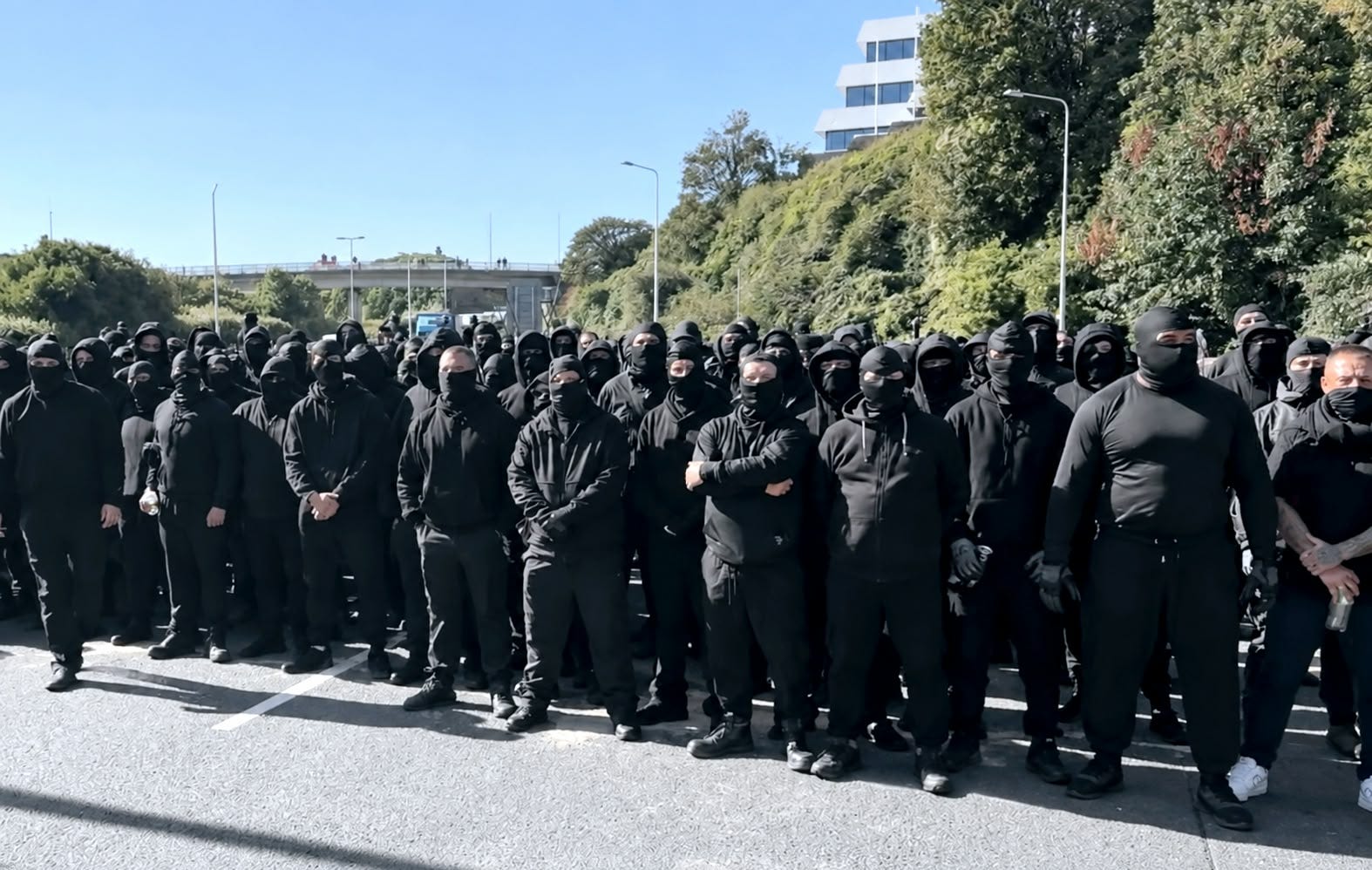
Two far-right mobilisations on the South Coast brought Patriot Platform to national attention within the space of a weekend. The first interrupted access to the Port of Dover. The second attempted to prevent people rescued in the Channel from being transported away from Portsmouth. Although the circumstances were different, Daniel Thomas—a long-term Tommy Robinson associate convicted of attempted kidnapping—occupied the leading role in both.
Dover had been prepared in advance. Hundreds of men received private instructions, travelled to the port and arrived dressed in black with their faces concealed. Groups entered the roads serving the port, formed lines across the carriageways and brought traffic to a halt. The disruption continued for several hours, affecting ferry operations and producing long queues around the port.
The mobilisation had remained hidden despite the number of people involved. Patriot Platform used email lists and peer-to-peer messaging to distribute information without issuing the sort of public call that would alert opponents or the police. Nevertheless, far-right streamers received sufficient notice to position themselves around the action. Their footage recorded the roadblocks, the interaction with drivers and the moments when protesters forced their way through police lines.
Tommy Robinson promoted the mobilisation after it had begun. His intervention placed Patriot Platform before an audience far larger than Thomas could reach independently and encouraged additional supporters to travel to Dover. This was a characteristic form of Robinson’s involvement: public endorsement and amplification without the burden of arranging the action himself.
Portsmouth developed under different conditions. The arrival of around 140 people rescued from a small boat was reported on Sunday evening. Thomas went to the port, began broadcasting and called upon supporters to join him. Protesters gathered around the roads used by the coaches intended to transport the new arrivals. They attempted to block the vehicles, confronted police officers and remained into the early hours of Monday. People were injured and vehicles were damaged.
The contrast between the two events helps establish what Patriot Platform is testing. Dover required secrecy, advance communication and the coordinated arrival of people from different areas. Portsmouth required Thomas to respond to an unforeseen development, publicise a meeting point and draw supporters into an escalating confrontation with little notice. One relied upon prior preparation; the other upon the exploitation of an immediate opportunity.
Thomas later called Dover a “dummy run”. The phrase deserves to be taken seriously because it identified the action as part of a continuing process. Blocking the port was intended to discover how many people would follow private instructions, whether they could arrive without advance publicity and how they would behave once deployed. Portsmouth provided a second, less controlled experiment.
None of this establishes that Patriot Platform possesses the discipline suggested by the clothing and formations at Dover. The confusion in Portsmouth, Thomas’s habit of exaggeration and the dependence of both events upon wider far-right networks all impose obvious qualifications. A body of men that can be brought together for several hours is not necessarily an organisation capable of sustained activity.
Yet, the weekend marked a development that requires investigation. Thomas had gathered hundreds of participants for a concealed action at a strategically significant location and then placed himself at the centre of another confrontation the following night. To understand what Patriot Platform represents, we must therefore look beyond its public launch and examine the campaigns, personalities and networks from which it has been assembled.
Who is Daniel Thomas?
Thomas is an unlikely architect of discipline. The 37-year-old former roofer from Havant has spent much of his political career around Robinson, working variously as his bodyguard, lieutenant and online promoter. In 2016, he was jailed for two years after admitting his role in an attempt to kidnap a man at knifepoint during a drugs feud in Portsmouth. He subsequently exchanged his real surname for “Tommo” and reinvented himself as an anti-migrant internet personality.
Thomas’s subsequent “campaigning” in Telford generated serious controversy over his own conduct. He was reported to have been arrested after identifying a girl living in care during a livestream. Thomas later said that the Attorney General had decided to proceed against him and that he could face six months in jail, although I have found no published judgment establishing the precise charge or outcome. The Morning Star separately reported allegations that Thomas had a sexual relationship with an adult woman whom Telford sources described as a survivor of child sexual abuse. When confronted, Thomas disputed that description and stressed that she was an adult. Thomas was building authority by claiming to defend survivors of sexual violence while serious questions were being raised about his own conduct.
Nonetheless, Thomas has established himself as a known name in the far right, primarily through his angry rants to camera on social media. During the racist riots that followed the murder of three young girls in Southport in 2024, Thomas told his followers that “every city needs to go up”. The statement recast the horror as proof of a national racial emergency and called for online rage to find physical expression.
Thomas has since tried to present himself as something more than another angry man with a phone. His broadcasts place him at beaches, ports and alleged scenes of crisis—the person prepared to travel, confront an enemy and demand action while others merely talk. The performance is frequently ridiculous, but it has given him a recognisable position inside Robinson’s movement.
Persistent questions about Thomas’s handling of money also predate Patriot Platform. US federal court records show that the Middle East Forum, a far-right think tank, agreed to give him $32,000 in 2018 to organise a pro-Robinson rally. Thomas estimated production costs at £17,700 while supplying a vendor invoice for £15,198. He later reported receiving £23,454 and retaining £1,454 for his hotel, travel and event-management expenses. MEF employee Lisa Barbounis complained that his accounting had left a “bad taste” and that two vendors were still seeking payment. MEF subsequently alleged that Thomas had misappropriated some of the grant, relying partly upon statements made during a recorded conversation. The judgment records that Thomas and Barbounis later began an affair. The court stressed that whether Thomas had misappropriated any money was “not clear”.
Later disputes suggest that this pattern has continued. Thomas sells access to his political personality through donations, subscriptions and merchandise, while each confrontation supplies material for the next broadcast. His conduct during his dispute with the leaders of the Raise the Colours group showed how aggressively he seeks to monetise this activity. Voice messages obtained by Searchlight recorded Thomas offering them access to his YouTube channel (and its almost 130,000 subscribers) while demanding that the organisation cover his rent, bills and family expenses. He described his own political advancement through the grandiose image of a pawn becoming a bishop and “close to a king”.
The exchange also revealed his instability. Thomas pleaded for admission to the leadership of Raise the Colours, considered abandoning Robinson when a more promising arrangement appeared available, and responded to rejection with threats and wounded vanity. Other comments suggested his emotional instability might be related to his use of anabolic steroids.
It would therefore be easy to treat Patriot Platform as another vehicle for a grifter. Doubtlessly, that description captures something real, but it is politically insufficient. Financial opportunism and ideological commitment are not mutually exclusive. The far right has always contained leaders who regard their supporters as sources of cash while remaining serious about the political projects through which that money is raised. Thomas’s income gives him the time to travel, broadcast, develop contacts and attempt operations that would otherwise require a conventional organisation to finance them.
His personal violence, appetite for confrontation and long association with Robinson also make it impossible to interpret Patriot Platform as simply a business venture wrapped in patriotic branding. Thomas wants status and money, but he also wants command. His abiding ambition is to distinguish himself from the multitude of far-right broadcasters by demonstrating that he can make people act.
Patriot Platform is the latest vehicle for that ambition. Its future will remain tied to the limitations of its founder: his vanity, avarice, aggression, broken relationships and braggadocious tendency to announce achievements before they exist. Yet, those weaknesses do not render the project harmless. The relevant question is not whether Thomas possesses the qualities he attributes to himself, but whether the networks around him can compensate for his instability long enough to establish something that survives his next dispute.
How Patriot Platform was assembled
Thomas has drawn upon a field of local groups formed through hotel protests, flag campaigns, opposition to asylum accommodation and repeated journeys to demonstrations elsewhere. Many people involved in Patriot Platform had already learned how to publicise an event, arrange transport, collect money, share intelligence and maintain contacts beyond their own town.
Raise the Colours demonstrated the potential of this environment. Covering bridges, roundabouts and town centres with flags could be copied without a complicated programme or formal branches. Local groups retained their identities while participating in a campaign that appeared to be present everywhere. Thomas attempted to attach himself to this network before his relationship with its leader, Ryan Bridge, disintegrated.
Still, failure is the midwife of invention. Thomas recognised that a new national project did not necessarily need to recruit isolated individuals one by one. Instead, it could gather organisers who already possessed local audiences and ask them to bring a section of those audiences into a common structure. Patriot Platform appears to have been constructed on that basis. Most of its identifiable support has come from southern England, although participating networks extend into other regions. Rather than conventional branches reporting through a public hierarchy, it brings together groups that continue to conduct their own campaigns while making activists available for selected national actions. The precise relationship between the centre and these groups remains unclear, as do the procedures through which decisions are made.
One important base for Thomas’s operations has been south-west London, where he has support among two overlapping fascist networks in Sutton and Merton. The first clusters around Billy Cooper, a construction worker with a conviction for insurance fraud. The second is centred around a scaffolding yard owned by a former British National Party activist. Both have attempted to acquire roots in local community life. Cooper, for example, has publicised his participation in activities at St Lawrence Church in Morden, attending the church with other activists. He has also promoted Patriot Platform in social-media posts tagged at the church. These activities illustrate how fascist networks can seek legitimacy and relationships through ordinary community institutions.
These networks provided the organisational backbone for Thomas’s summer tour of towns and cities, which became the foundation for Patriot Platform. Thomas claims to have “handpicked” participants according to “quality over quantity”. He has spoken about vetting recruits, excluding suspected informants and selecting people capable of following instructions. Some of these statements are promotional claims by a habitual self-publicist and narcissist. Dover nevertheless supplied evidence that a private communications system existed and that large numbers had been willing to accept its directions.
The clothing imposed another elementary form of compliance. Black uniforms and concealed faces created the appearance of a single body, but they also required participants to arrive equipped in a particular way and subordinate their individual identities to the presentation chosen by the organisers. Forming lines across the roads then provided a simple collective task. Neither feature proves military discipline, but both show an attempt to move beyond the informality of a crowd assembled through an open Facebook post.
Thomas distinguishes Patriot Platform from the drunkenness and uncontrolled behaviour associated with parts of Robinson’s street following, but that claim should not be mistaken for a rejection of violence, especially by a man with a serious conviction for a crime involving a knife. Discipline can mean regulating violence, choosing its timing and directing it towards an agreed objective. Indeed, the organisation’s combination of masks, secrecy and confrontational action is difficult to reconcile with its public claims to stand merely for peaceful community protection.
Thomas is attempting to distinguish the person who watches, shares or occasionally attends a demonstration from the activist who can be contacted privately, trusted with information and asked to travel. His grandiosely named “Operation Overlord” (a planned series of forays to northern France to intimidate refugees and charity workers, which ended abruptly in the French state banning Thomas from its territories) had already produced attempts to collect details, arrange meetings and sort supporters geographically. Patriot Platform brings those practices back onto the British mainland.
Yet, it is not known how many of the men at Dover regard themselves as members or would return for a less dramatic assignment. Patriot Platform currently resembles a selection process operating across a network more than a completed national organisation. Nevertheless, Dover is significant because that process produced a concrete result.
The cameras and the crowd
The streamers at Dover were part of a concerted communications strategy. Anthony Barnes, better known as AY Audits, was present before an action whose location had otherwise been concealed. Others recorded the blockades from different positions, producing a continuous supply of images as the men moved into the roads and confronted police. Robinson then distributed selected footage through his own channels. A communications strategy was thus built in from the beginning.
The arrangement combined restricted information before the action with unrestricted distribution once it began. Opponents were denied time to respond, while supporters watching online were encouraged to experience events as they unfolded. The same cameras that revealed the mobilisation to the wider public allowed its organisers to determine much of its initial meaning.
Thomas performed this role himself in Portsmouth. He broadcast from the port, issued claims about the movements of the coaches and encouraged people to travel towards him. Viewers encountered the evening directly through Thomas’s account of an invasion being protected by the state and a local population beginning to resist. They were also treated to the surreal drama of Thomas wading into the water to evade arrest while shouting at police officers that he would kill himself if they approached him, suggesting that they would face “manslaughter” charges as a result.
This relationship between filming and acting has been developed through years of anti-migrant content. Far-right activists travel to hotels, beaches and the French coast partly because these places offer confrontations that can be broadcast as proof of their commitment. A failed attempt to intercept migrants, an argument with a charity worker or an intervention by the police can all be presented as evidence that the activist has entered territory abandoned by the authorities.
The income generated by these encounters provides a material incentive for mobilisation. Donations and subscriptions help pay for travel, equipment and the continuous political availability upon which Thomas’s reputation depends. More importantly, the broadcasts create relationships between the personality on the screen and a dispersed audience. Repetition allows viewers to acquire a shared vocabulary, identify enemies, recognise allies and become familiar with the expectation that action may be required.
Most will remain viewers. Others will donate, distribute footage or attend a public demonstration. Thomas is trying to identify the smaller number prepared to give contact details, join closed communications, travel without public advertising and accept collective instructions. The production of content and the construction of a network therefore overlap.
The visual presentation at Dover served this process. Uniformed clothing, masked faces and ordered lines communicated seriousness to an audience accustomed to seeing far-right protests as untidy gatherings dominated by alcohol and personal quarrels. People attracted to the image were being invited to imagine themselves not simply attending the next protest but joining a select team.
This is why laughter at Thomas’s theatrics is an inadequate response. Much of what he does is absurd, and his claims routinely exceed reality. Nevertheless, political theatre can recruit people who want the identity it offers. The danger arises when the imagined force becomes incarnate in real men threatening real violence.
From crowds to targeted action
Patriot Platform has emerged after two years of recurrent racist violence. The riots of August 2024 demonstrated how quickly inflammatory posts, false information and accumulated anti-migrant agitation could bring thousands of people onto the streets. Crowds attacked mosques, assaulted racialised people and attempted to burn asylum seekers alive inside their accommodation. The violence was enormous, but the organisations directing it were often weak or absent. Open calls circulated across national influencer accounts, local Facebook groups and private chats before being interpreted by whoever arrived.
Such crowds can overwhelm the police for several hours and then disappear. Participants may never meet again, while online personalities deny responsibility for consequences they helped make possible. Southampton reproduced many of these characteristics. The killing of Henry Nowak was a genuine atrocity. His father pleaded for people not to exploit the death to create further division. Nonetheless, the case was incorporated into a national far-right narrative about “anti-white” violence. Nigel Farage promoted the grievance before Robinson and his supporters gave it a more aggressive street expression.
Around a thousand people assembled outside Southampton Central Police Station to hear Robinson and other prominent speakers. Thomas was central, giving the word from the stage for the crowd to march through Asian areas of the city. Alcohol circulated, missiles were thrown and eleven police officers were injured. The mobilisation was capable of serious violence, but its participants dispersed and the confrontation did not spread nationally.
Belfast revealed a different possibility. Groups of masked men used local knowledge to identify homes, businesses and vehicles associated with minority communities. Arson, threats and attacks continued across several nights. Families were driven from their homes. The purpose was to punish an entire population and determine who could safely inhabit particular streets.
The word pogrom should not be cheapened into a synonym for disorder. In Belfast, however, it well described an attempt to remake local space through racial terror: to identify populations, mark territory and impose new boundaries by force. The relatively small numbers involved were no measure of their political weight. Their power lay precisely in organisation—the prior identification of targets, the circulation of local knowledge, and the repeated use of violence until fear itself acquired a territorial effect.
Thomas travelled to Belfast after the violence had begun. This is not evidence of the mechanical importation of a single Northern Irish model. It is evidence of something more significant: that Belfast was regarded as a field of practical instruction. Its lessons were organisational rather than merely ideological—masked groups, locally accumulated intelligence, repeated deployments, and the capacity to sustain intimidation without the theatrical concentration of a national rally.
Thetford subsequently displayed related tendencies in England. Lists of properties supposedly housing asylum seekers circulated locally. Across three nights, crowds moved against particular houses, smashed windows, damaged fences and attempted to force entry. Police officers were attacked and asylum seekers were removed for their own safety. Regular protests at nearby RAF Barnham had already created an anti-asylum milieu around the town. Robinson’s channels then turned footage of the attacks into evidence of a wider revolt.
Southampton, Belfast and Thetford thus represent distinct routes from agitation to violence. Southampton shows how a catalytic event can produce a large, aggressive crowd around nationally recognised figures. Belfast shows how smaller groups can use repeated and selected attacks to terrorise a population. Thetford shows how a local anti-asylum campaign can accumulate information about properties and people before a crowd moves against them.
Dover added another form: a concealed mobilisation directed towards infrastructure rather than a residential target. Portsmouth then placed Thomas inside a more open and improvised confrontation. Patriot Platform appears interested in the elements that can persist across these different situations—trusted contacts, rapid communication, willingness to travel, common presentation and the acceptance of direction.
The organisation need not replace larger protests to become dangerous. A selected group can operate within a crowd, move at its head or remain available after it disperses. It can also reinforce local activists whose numbers would otherwise remain small. The importance of Thomas’s experiment lies in the possibility that people developed through episodic confrontations may become available for repeated ones.
The camps and the Channel
The human material for such a project has accumulated through hotel protests, flag campaigns and travel between demonstrations. These activities have brought local residents, established fascists, internet personalities and new activists into contact.
The large asylum camps at Crowborough and Wethersfield are particularly important because they give the politics of the border a permanent local address. Agitation at Crowborough began before the first asylum seekers even arrived. Rumours about movements into the former military camp produced night-time vigils, drone surveillance and a volunteer street patrol equipped with high-visibility clothing and radios. Ordinary buses were mistaken for secret transports carrying migrants. A fabricated report of an attack with a hammer helped bring people onto the roads.
Each falsehood became evidence for the next. The absence of confirmation merely proved that the authorities were concealing the truth. Participants monitored vehicles, buildings and unfamiliar people while sharing their findings online.
The Crowborough campaign attracted thousands, although it would be wrong to describe every participant as a fascist. Racial animus is a necessary but insufficient condition for such identification. Nonetheless, using former military facilities to isolate refugees is punitive towards them and creates the conditions for the expansion of fascist organising. Describing asylum seekers as people being “dumped” upon an area makes their presence the cause of every local problem. Fascists can then present themselves as the most consistent section of the campaigns against these sites.
Wethersfield has performed a similar role over a longer period. The former RAF base has housed asylum seekers since 2023. The Braintree and Wethersfield Protest Group has organised repeated demonstrations, including a sizeable march attended by Robinson.
Regular activity produces organisers who can arrange meeting points and sustain attention after national media interest declines. It also identifies people prepared to travel. Patriot Platform can approach local groups whose leading participants have already been tested through months of agitation.
The Channel has supplied another training ground. British far-right activists have travelled to northern France to film refugees, intimidate aid workers and perform their own version of border enforcement. Alan Leggett, known online as Active Patriot, was followed by UKIP leader and third-rate Oswald Mosley impressionist Nick Tenconi. Thomas and Raise the Colours then helped launch Operation Overlord in late 2025.
Investigations by Juliette Démas and Maël Galisson exposed the opportunism, violence and theatre involved. Activists confronted Sudanese refugees, shone lights into the faces of people sleeping outside and harassed humanitarian workers. Empty dinghies were slashed and presented as if a smuggling operation had been defeated.
Yet, Operation Overlord cannot be understood only through the gap between its claims and achievements. Appeals were issued for stab-proof vests, thermal cameras, drones and encrypted radios. Potential recruits supplied personal details that could be used to map supporters “county by county, city by city”. They were offered face-to-face meetings and filtering procedures intended to exclude anti-fascists and suspected informants.
Sociologist Matthijs Gardenier has described how anti-migrant patrols in Dover and Calais stage what he calls a “spectacle of vigilance”. Their immediate practical achievements were usually limited, but livestreams and videos allowed small groups to present themselves as participants in border enforcement and assemble what Gardenier terms a “communitarian audience”. Operation Overlord extended this established repertoire.
The announced mass deployment failed, and several leading participants were banned from France. Nonetheless, the recruitment process distinguished between the large audience attracted by the publicity and the smaller number willing to provide information, buy equipment or travel. It gave Thomas experience of using an operation to gather contacts and sort them geographically even when the operation itself ended in farce.
The expeditions also connected British activists with French identitarian networks. French groups attended Robinson’s demonstrations and developed relationships around the demand for “remigration”. These links remain fragmented but allow tactics and political identities to circulate across the border.
Crowborough, Wethersfield and northern France are therefore connected environments. The camps provide durable local targets around which organisers can accumulate knowledge and relationships. The French coast offers opportunities for vigilantism presented as direct participation in border control. Patriot Platform is attempting to draw activists produced by both into a national network available for further action.
Organisation without a centre
The relationship between Thomas and Robinson helps explain why Patriot Platform has developed in this form. Robinson stands at the centre of British fascism without leading a conventional membership organisation. He connects local campaigners, donors, streamers and smaller groups through his ability to distribute attention and political authority. His approval can transform an obscure protest into a national event, but he does not possess a stable chain of command through which every participant can be directed.
This arrangement has considerable advantages. There is no complete membership list, branch structure or constitution through which responsibility can be fixed. Local activists can describe their actions as spontaneous expressions of community anger while Robinson benefits from the atmosphere they create. He can amplify a mobilisation without undertaking its preparation and retreat when an initiative becomes damaging.
The model also reflects the defeat of earlier party-based fascisms. The structures of the National Front and British National Party gave anti-fascists clear targets and made responsibility difficult to evade. Robinson has achieved a much larger audience through personal influence and digital distribution.
Yet, decentralisation produces its own problems. Followers are not necessarily activists. Local groups appear, split and vanish. Organisers become absorbed in disputes over money, ownership and recognition. A national demonstration can bring tens of thousands into London without leaving a functioning organisation behind when the stages are dismantled.
Those limits became visible on 16 May, when Robinson attempted to reproduce the enormous Unite the Kingdom mobilisation held the previous September. The later demonstration remained huge by ordinary standards: my estimate placed it at approximately 35,000, while the police claimed 60,000. Tens of thousands marching behind a fascist leader cannot be dismissed. However, Robinson had previously mobilised around 110,000 and promised to repeat that scale every six months.
The screens along Whitehall faced noticeably thinner crowds, while Robinson’s claim that “millions” had attended advertised the discrepancy between promise and reality. September had attracted families, younger people and layers generated through anti-asylum agitation. May retained a hardened following that was older, more male and more recognisably connected to the traditional EDL milieu. There is no doubt this would have stuck in Robinson’s throat. His national gatherings depend upon each event announcing a movement larger than the last. Falling numbers weaken the promise of irresistible advance upon which their political effect depends.
Patriot Platform offers a partial response to this problem. Thomas can attempt the slower work of identifying organisers, vetting participants and directing smaller actions without Robinson establishing a party or assuming operational command. Robinson can contribute publicity at decisive moments. Their interests overlap without becoming identical. Thomas gains recruits and standing through proximity to Robinson, and Robinson gains access to a potentially more dependable formation while remaining distant from its decisions. Local organisers gain national attention without surrendering every initiative.
Different scales of mobilisation can therefore coexist. Robinson convenes national demonstrations, Thomas prepares smaller actions, and local groups sustain pressure around asylum accommodation. No headquarters needs to control every level.
This is an adaptation born from weakness as well as strength. A decentralised movement can survive the collapse of one organisation, but it struggles to impose discipline across the whole. Patriot Platform may help overcome that fragmentation, but in doing so it creates a visible leadership, communications structure and collective identity that can be investigated and opposed. It also places substantial weight upon Thomas, whose record offers little reason to assume organisational stability or professionalism.
Patriot Platform is consequently neither Robinson’s obedient street wing nor a completely independent initiative. It is an experiment conducted within the political space Robinson created. Whether it becomes important depends upon its ability to secure the benefits of his audience without reproducing the volatility that has repeatedly consumed organisations around him.
Political permission and selective distance
The reactions of Reform and Restore to Dover exposed the wider political environment in which this experiment is occurring. Neither party organised Patriot Platform, but both recognised that its supporters belonged to a constituency they hoped to influence.
Nigel Farage called the masked men “disgusting” and declared balaclavas at demonstrations wrong “at every level”. Other Reform figures condemned the intimidation and anonymity. The party sought to appear as the defender of borders and public order against a mobilisation it did not control.
Nonetheless, its representatives accepted the account of migration used to justify the action. Farage paired his condemnation with the insistence that nobody had done more to warn about the supposed disaster of Channel crossings. He later contrasted the masked blockade at Dover with what he called the “huge, spontaneous protest” in Portsmouth, despite Thomas’s leading involvement in both.
Zia Yusuf travelled to Portsmouth and supported people expressing “outrage, anger and terror”. He blamed the government for triggering disorder by protecting asylum seekers. When Thomas confronted him during an interview, Yusuf asked only that Patriot Platform supporters refrain from attacking police officers. The racial interpretation of the crisis remained intact.
Rupert Lowe attempted to occupy the ground Reform had partially vacated. The Restore Britain leader described Britain as “effectively invaded”, repeated claims about “two-tier policing” and declared support for the Dover “patriots”, although he conceded that the masks and black clothing were undesirable. His intervention made the competition explicit: activists condemned too sharply by Reform could be courted by a harder electoral project.
The distinction involved methods, authority and presentation—not a clean division between incompatible political worlds. Reform wants anger against migration expressed through a party seeking government. Restore is more willing to endorse activists whose conduct challenges that respectability. Thomas, meanwhile, presented his followers as a possible “voting bloc” available to whichever party treated them with sufficient respect.
This does not make Reform responsible for actions it did not organise. It does show how political language can validate the premise of far-right mobilisation while disapproving of the form it takes. When parties describe refugees as an invading force and the border as an existential emergency, people who attempt their own enforcement can present themselves as implementing conclusions already accepted elsewhere.
What has Patriot Platform built?
Patriot Platform remains a small, unstable and highly personalised formation. Thomas’s claims of national reach, careful vetting and internal discipline cannot be accepted without qualification. His previous projects have failed to match their announcements, his alliances have ended in recrimination and his need to remain at the centre of every event may obstruct the development of organisers capable of acting independently.
Nor should the men at Dover be mistaken for a trained force. Wearing identical clothing and following instructions for several hours do not demonstrate the ability to sustain a campaign, withstand arrests or resolve internal disagreements. Portsmouth showed many of the familiar features of far-right mobilisation: improvisation, confused information, competing livestreamers and violence developing through the dynamics of the crowd.
Yet, dismissing Patriot Platform as a game of dress-up would ignore what occurred. Hundreds of people accepted private instructions and travelled to a concealed action. Existing local groups participated in a common undertaking. Streamers arrived in advance, Robinson amplified the mobilisation after it began and Thomas placed the result before potential recruits as evidence of what could be achieved.
The organisation should therefore be understood through its direction rather than its inflated self-description. Thomas is trying to identify dependable activists within the much larger audience created by Robinson, anti-asylum campaigns, flagging networks and Channel vigilantism. He wants people who can be contacted away from public platforms, moved between localities and used in planned actions or sudden confrontations.
That development can be stopped. The enormous anti-racist mobilisation in Glasgow after violence spread from Belfast showed that years of local work can produce a response capable of substantially outnumbering an attempted far-right advance. Repeated counter-demonstrations on the South Coast have prevented anti-asylum groups from claiming uncontested ownership of local opinion. Such organisation must now become faster, more widely connected and capable of reinforcing threatened communities beyond the resources available in a single town.
Dover was not proof that Thomas has built the organisation he imagines. It was evidence that he has begun testing its components. His description of the blockade as a “dummy run” was therefore both boast and warning. The result of an experiment is not predetermined. It depends upon what happens when its organisers attempt to run it again.